How to Convert a Logo to DST Format
Professional embroidery digitization transforms raster images into machine-readable DST files with optimized stitch paths, proper density, and thread color matching—no expensive software required.
What is DST Format and Why Embroidery Machines Need It
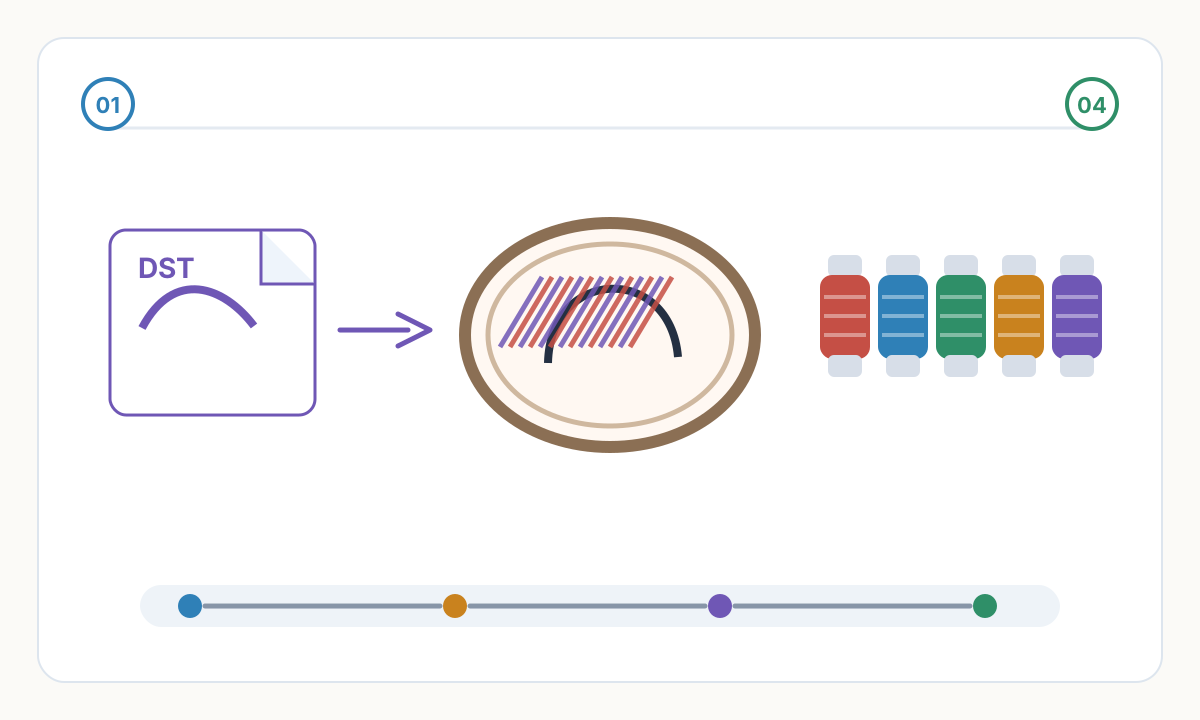
DST (Tajima format) is the universal standard file format for commercial embroidery machines. Unlike image files (PNG, JPG) that store colored pixels, DST files contain precise stitch coordinates, thread colors, and machine instructions that control needle position, stitch type, and color changes.
Embroidery machines cannot interpret photographs or vector graphics directly. They require explicit stitch-by-stitch instructions: where to place each needle penetration, when to trim thread, when to change colors, and how to transition between design elements. DST provides this machine language.
A quality DST file includes proper underlay stitches for fabric stability, optimized stitch density to prevent puckering or gaps, balanced fill angles to avoid distortion, and intelligent color sequencing to minimize thread changes and production time.
The conversion from logo to DST is called digitizing—a specialized skill that requires understanding fabric behavior, thread tension, stitch mechanics, and design aesthetics. Professional digitizing ensures designs sew cleanly on the first run without machine jams, thread breaks, or registration errors.

Manual Digitizing vs Automated Conversion: Understanding the Difference
Traditional manual digitizing costs $15-50 per logo and requires 2-4 hours of expert work using software like Wilcom ($10,000+) or Pulse ($8,000+). The digitizer manually traces design elements, assigns stitch types, adjusts densities, and tests on real fabric.
Automated digitizing uses advanced algorithms to analyze images, detect boundaries, classify regions, generate stitches, and optimize paths—delivering results in 60 seconds instead of hours. Modern AI-powered systems achieve quality comparable to manual work for clean, high-contrast logos.
The key difference is decision-making. Manual digitizers make subjective choices about detail simplification, stitch direction, and underlay strategy. Automated systems apply proven production rules: fabric-specific densities, tested stitch angles, standard underlay patterns, and thread catalog matching.
For simple-to-moderate logos (2-8 colors, clear boundaries, minimal gradients), automated digitizing produces production-ready files at a fraction of the cost. Complex designs with fine details, photographic elements, or artistic effects may still benefit from manual intervention.
Logo to DST Conversion Workflow
- 1
Prepare Your Logo File
Use a high-resolution PNG or JPG (minimum 1000px wide) with clean edges and solid colors. Remove backgrounds, ensure high contrast, and avoid gradients or shadows. Vector files (SVG, AI, EPS) work best but aren't required. The clearer your input, the better the stitch quality.
- 2
Set Design Dimensions
Specify the physical width in millimeters (typically 50-100mm for chest logos, 300-400mm for back designs). The system calculates stitch density based on fabric type and design size—smaller designs need denser stitches, larger designs can be slightly looser.
- 3
Choose Color Count and Thread Brand
Select 4-8 colors for clean separation. More colors mean more thread changes and longer production time. Choose a thread brand (Brother, Janome, Madeira) for accurate color matching from a 293-thread catalog, or use universal matching for closest available colors.
- 4
Select Fabric Type
Standard woven fabrics use normal density. Stretchy knits (polos, athletic wear) need denser stitches and compensation for fabric pull. Heavy materials (denim, canvas) use slightly reduced density to avoid stiffness. Delicate fabrics need lighter underlay and lower density.
- 5
Download and Test
Download the DST file and transfer to your machine via USB. Run a test stitch on scrap fabric first—check registration, thread tension, and color sequence. Adjust machine settings if needed: reduce top tension for puckering, increase speed for production runs.
Quality Factors That Separate Good DST Files from Bad Ones
Stitch density determines fill coverage and final appearance. Too dense causes fabric puckering, needle deflection, and thread breaks. Too loose creates gaps, poor coverage, and visible fabric background. Proper density varies by fabric: 4-5 lines/mm for standard cotton, 5-6 for stretchy knits, 3-4 for heavy canvas.
Underlay stitches stabilize fabric before decorative stitches. Running underlay for narrow columns, edge-run for medium areas, zigzag for wide fills. Without proper underlay, designs shift during sewing, outlines don't align, and fabric bunches. Good DST files include appropriate underlay automatically.
Stitch direction (fill angle) affects how light reflects off thread and how fabric compresses. Varying angles between adjacent colors creates visual separation. Parallel angles in touching areas cause push/pull and registration errors. Proper angle planning prevents distortion.
Thread color sequencing minimizes changes and optimizes production flow. Good DST files group same-color elements and sequence from interior to exterior, dark to light, or by logical layer order. Poor sequencing causes excessive trimming, longer production time, and potential registration drift.
Push/pull compensation accounts for fabric distortion under stitch tension. Dense fills compress fabric and shift outlines. Compensation slightly expands underlying elements so final sewn result matches intended dimensions. Critical for multi-layer designs and precise text.
Pre-Production Quality Checklist
- Stitch count reasonable for design size: 50-100mm logos typically 3,000-8,000 stitches. Excessively high counts indicate over-density or unnecessary detail that slows production.
- Color changes limited to 2-8: each change adds 10-15 seconds and trim tails to bury. Minimize changes for production efficiency.
- No overlapping duplicate stitches: causes thread buildup, needle deflection, potential thread breaks, and uneven surface texture.
- Proper underlay present: check for running stitches before narrow columns, edge or zigzag before wide fills. Missing underlay causes shifting.
- Minimum feature size appropriate: details smaller than 2mm may not sew cleanly at normal densities. Simplify or remove tiny elements.
- Jump stitches minimized: excessive jumps between elements waste thread and create trim work. Intelligent pathing reduces jumps.
- File opens in machine software: test import in your embroidery machine's software or simulator to verify format compatibility and detect errors.
Can I convert any image to DST, including photographs?
Photographs require different treatment than logos. Photos with gradients, shading, and complex details need to be simplified into distinct color blocks first. Photo-realistic embroidery uses special techniques (photo stitch, gradient fills) that standard DST conversion doesn't support. For best results, use clean logos, icons, or simplified graphics with solid colors and clear boundaries. Complex photos should be professionally digitized with artistic interpretation.
How much does automated DST conversion cost compared to manual digitizing?
Manual digitizing typically costs $15-50 per design from professional digitizers, with turnaround times of 24-48 hours. Complex designs may cost $75-150. Automated services range from $5-20 per design for instant delivery, or subscription models for unlimited conversions. The cost difference is significant, especially for businesses digitizing multiple designs monthly. Automated conversion works well for 70-80% of common logo types.
Will the DST file work on my specific embroidery machine brand?
DST is the universal standard supported by virtually all commercial and home embroidery machines: Brother, Janome, Bernina, Singer, Babylock, Husqvarna, Pfaff, and commercial brands like Tajima, Barudan, and ZSK. Some machines prefer their native format (PES for Brother, JEF for Janome) but all read DST. If your machine software shows an error, try PES format as an alternative—both are typically provided.
What if my logo has gradients or photographic elements?
Standard embroidery digitizing works best with solid color blocks. Gradients must be simplified into 2-4 distinct color steps rather than smooth transitions. Photographic shading requires advanced techniques like density variation or specialty threads that most automated systems don't support. For gradient logos, consider simplifying to flat colors first, or use photo-stitch specialty services. Most corporate logos work fine with solid color conversion.
Prepare cleaner production files with Pixel2Lines
Use Pixel2Lines when you need artwork converted into cleaner SVG, DXF, embroidery, or machine-ready outputs before production.
Start with Pixel2Lines
Comments
Loading comments...